Out of the Archives: Female Life on the Spectrum with Jennifer Cook
September 11, 2026
September 11, 2026



FEATURED POSTS


BY KATHERINE JOHNSON, M.S., BCBA
SENIOR DIRECTOR OF PARTNERSHIPS
Looking back at 2021, there were significant developments, both in research and thought leadership, in the field of autism and applied behavior analysis (ABA). Here are some studies and papers you don’t want to have missed!
2021 gave us another important building block in the ongoing investigation in to how and why autism manifests differently in girls than in boys. A study by Jack et. al. found that there was a much greater difference in brain activity in autistic and non-autistic girls, than was previously found between autistic and non-autistic boys when viewing biological motion. In the second half of the investigation, they looked at the girls’ DNA. What they found (greater differences in brain activity and more gene mutations among the girls) bolsters the “Female Protective Effect” theory, which holds that girls require more genetic predisposition to autism in order to show autistic traits. Inquiries into how autism manifests differently depending on sex is integral to being able to more accurately identify and support girls on the spectrum.
Allison Jack, Catherine A W Sullivan, Elizabeth Aylward, Susan Y Bookheimer, Mirella Dapretto, Nadine Gaab, John D Van Horn, Jeffrey Eilbott, Zachary Jacokes, Carinna M Torgerson, Raphael A Bernier, Daniel H Geschwind, James C McPartland, Charles A Nelson, Sara J Webb, Kevin A Pelphrey, Abha R Gupta, the GENDAAR Consortium, A neurogenetic analysis of female autism, Brain, Volume 144, Issue 6, June 2021, Pages 1911–1926, https://doi.org/10.1093/brain/awab064
Many behavior analysts have heeded the call to focus on their own cultural competence and anti-racism work; this paper outlines ways they can put those skills to good use. Crowe and Drew review the history and current state of a social injustice faced by many people with disabilities: segregation via incarceration. The authors posit that behavior analysts can help to interrupt the “school-to-prison pipeline” and outline their theory. Although the authors call for a grand restructuring of the prison system (including abolition of the current system), they also offer thoughts on how behavior analysis could improve current institutions.
Crowe, B., & Drew, C. (2021). Orange in the new asylum: Incarceration of individuals with disabilities. Behavior Analysis in Practice, 14(2), 387-395. https://doi.org/10.1007/s40617-020-00533-9
If you have been following the conversation about ABA and neurodiversity, you’ll want to read this paper. A group of Autistic and Non-Autistic authors challenge the belief that ABA is inherently harmful for Autistic people and proposes the perspective that behavioral interventions can be “compatible with the neurodiversity paradigm.” After a history of autism and behavioral interventions, the authors delve into a thorough discussion of how Naturalistic Developmental Behavior Interventions may bridge the gap between opposing viewpoints about the use of behavioral interventions with people on the spectrum.
Schuck RK, Tagavi DM, Baiden KMP, Dwyer P, Williams ZJ, Osuna A, Ferguson EF, Jimenez Muñoz M, Poyser SK, Johnson JF, Vernon TW. Neurodiversity and Autism Intervention: Reconciling Perspectives Through a Naturalistic Developmental Behavioral Intervention Framework. J Autism Dev Disord. 2021 Oct 13. doi: 10.1007/s10803-021-05316-x. Epub ahead of print. PMID: 34643863.
And the Functional Analysis (FA) gets another twist! Thomas et. al. assessed whether or not paying attention to indices of happiness would assist in finding effective interventions to decrease challenging behavior. They found that when interventions were derived from what they learned about the children’s happiness, they were as effective as interventions based solely on the function of the challenging behavior, and they were associated with more behavior associated with happiness. In the search for effective treatments that are maximally acceptable to consumers, this is a useful addition to the FA!
Thomas BR, Charlop MH, Lim N, Gumaer C. Measuring Happiness Behavior in Functional Analyses of Challenging Behavior for Children with Autism Spectrum Disorder. Behav Modif. 2021 May;45(3):502-530. doi: 10.1177/0145445519878673. Epub 2019 Sep 30. PMID: 31565953.
With the addition of “assent” to the BACB Code of Ethics, behavior analysts have begun the search for research, resources, and materials on the topic. After a discussion of the federal statute and how it may or may not apply to autistic subjects, the authors discuss assent in the context of the behavior analytic values of self-determination and choice. They then examine how frequently assent has been obtained in the behavior analytic research (spoiler alert: not frequently), note the methods that have been used, and propose a procedure for obtaining assent from nonverbal potential research participants. This may be the only JABA article on assent in 2021, but it’s a fair bet that it will inspire many more in 2022.
Morris C, Detrick JJ, Peterson SM. Participant assent in behavior analytic research: Considerations for participants with autism and developmental disabilities. J Appl Behav Anal. 2021 Sep;54(4):1300-1316. doi: 10.1002/jaba.859. Epub 2021 Jun 18. PMID: 34144631.
In a year when the pandemic kept many families at home and on their screens, many Americans turned to podcasts to fill their downtime. At LEARN Behavioral, we’re no exception.
We recently reached our 100th podcast milestone on All Autism Talk, where we’re connecting the autism community one podcast at a time. In celebration of today—International Podcast Day—we’re launching a new podcast with Temple Grandin discussing her latest book, Navigating Autism: 9 Mindsets for Helping Kids on the Spectrum. We’re also bringing you 10 of our highly popular episodes:
In one of our most-listened-to podcasts, Temple Grandin, PhD, an American scientist and animal behaviorist who has been a trailblazer for people with autism, shares advice for parents raising kids on the spectrum. Drawing from her experiences growing up with ASD, she talks about everything from sensory overload and excessive screen time to the need for more 1950s-style “old-fashioned methods of parenting” full of “teachable moments.”
Jennifer Cook O’Toole was diagnosed with Asperger’s syndrome at age 35 and is raising three children on the spectrum. She’s the author of seven award-winning books, including Autism in Heels: The Untold Story of a Female Life on the Spectrum. In this engaging and, at times, humorous podcast, she explains why diagnosis has been widely missed in girls and women.
Corina Jimenez-Gomez, PhD, a behavioral scientist at Auburn University, and Lauren Beaulieu, PhD, a behavior analyst for Newton Public Schools in Massachusetts, team up on this podcast to talk about cultural competency and the importance of cultural responsiveness in ABA. They bring personal experience to the conversation, with Corina sharing stories of her experience as a mom and Venezuelan native, now living in Alabama, and Lauren discussing her marriage to an Italian immigrant. Both say relationship-building is an important part of navigating what can sometimes feel like a clash of cultures.
Dr. Sharief Taraman is a neurologist at Children’s Health of Orange County (CHOC). In this episode, he discusses how diagnostic screening can help identify developmental delays in children. Early identification and diagnosis, he says, can help families get the right treatment right away.
Hanna Rue, PhD, Chief Clinical Officer at LEARN Behavioral, eases parents’ minds in this conversation about what they can expect when it comes to applied behavior analysis (ABA) providers. How do providers apply our understanding of how behavior works to real situations? How do they help increase behaviors that are helpful and decrease those that are harmful for learning? Listen in to learn more.
Wendy Chung, MD, PhD, director of clinical research at the Simons Foundation Autism Research Foundation, works as a molecular geneticist and physician and is something of a genetic detective who traces an individual’s symptoms to a particular genetic anomaly. In this podcast, she breaks down what we know about the causes of autism.
A mother’s intuition and drive to advocate for her kids can make her the best expert when it comes to her child’s care. That’s something Debora Smith understands to the core. She’s raising a son on the autism spectrum, and she founded Autism Resource Mom, a nonprofit organization that helps families navigate the complex world of autism. Listen in to find out how she’s turned her passion into helping others.
More than a decade ago, Amy Lutz and her husband, Andy, struggled with a predicament no parents want to face: how could they safely keep their autistic 10-year-old son living at home any longer, considering his violent rages? Amy, a founding board member of the National Council on Severe Autism, discusses their exploration of the controversial procedure of electroconvulsive therapy, or ECT.
As a single father, Stuart Duncan has been all about his kids. His oldest son has autism, and Stuart noticed that kids on the spectrum need a space online where they can play games without getting bullied. So, the Canadian dad quit his job to create Autcraft, a Minecraft server for kids with autism. His virtual community has given people on the autism spectrum the self-confidence to socialize on a safe gaming platform.
Will your health insurance cover your child’s autism treatment? In this podcast, Amy Weinstock, Director of the Autism Insurance Resource Center at the University of Massachusetts, breaks down tools that can help families find out whether they are covered.
Find dozens of more episodes from All Autism Talk wherever you get your podcasts, including Apple Podcasts, Google Podcasts, Spotify, Stitcher, Amazon Music, or on LEARN Behavioral’s website at www.learnbehavioral.com/allautismtalk.
Many people think of speech-language pathologists (Speech Therapists or SLPs)as professionals that work with people to improve their speech (also called articulation or fluency), but a big piece of SLPs job is to help children with language development. Language is so important for individuals to function in school and life. When children have a developmental delay that impedes their ability to effectively communicate, SLPs work with parents, teachers and other caregivers to develop strategies that improve language acquisition.
Children learn language and communication from their environment and from their experiences and interactions with the people in their environment. Studies have shown that on average, about 90% of the words used by children by the age of three come from their parents’ vocabularies. Children imitate the number of words spoken, the length of conversations and the speech patterns of their caregivers.
This is why it is so important for parents and caregivers to actively engage their infants and children by talking to them as much as possible. The number of words a child hears per day will greatly impact their vocabulary and their language development, and ultimately this impacts success in many other areas for children as they develop. It does not need to be complicated- simply noticing your environment and commenting on it to your child is all it takes to stimulate your child’s learning of language and communication. It’s the frequency that matters.
One of the easiest ways to encourage the learning of language and communication is by encouraging talking during your normal, daily routines. Activities such as bathing, dressing, mealtimes, cooking, doing laundry, going for a walk, driving in the car, and grocery store shopping are all typical daily routines and activities during which you can embed all kinds of important skills that we want kids to learn (see reverse for 10specific ideas).
When looking at pictures, reading books, or even just playing with children, it is important that the child looks at the object, picture, or toy that you are talking about. This ensures that the child is listening and is able to understand the object or picture being labeled and described.
Teaching children to respond to physical and verbal directions sets the stage for understanding how to share between two people. For example, when playing with a toy car, if the parent pushes the car to the child and says “vroom-vroom”, the parent waits for the child to respond by pushing the toy car back to them and imitating the sound.
During all kinds of daily activities, talk to your child about what you are doing, seeing, hearing, etc. in your environment.
Through play, children often show us what they understand about the world. This is how children discover and learn about objects, people and the world around them. Play with your child often and talk as you play about what you are doing.
Set up a predictable, language routines, for example, set up a familiar phrase and purposefully leave out the last word, i.e., While singing “the wheels on the bus go round and ____, round and _____.” Or while reading “brown bear, brown ____.” Gradually make the task more complicated, i.e., during a favorite book, you can exclaim, “Oh, no…look…Clifford is laughing…he feels ____.” Prompt your child by looking at them and waiting for them to reply. Once you do this a few times, they will catch on.
Provide choices instead of asking questions so your child does not have the option of answering “no” when you want to stimulate interaction. Instead of asking your child “Do you want to play with your cars” ask “Do you want to play with your cars or train?”
It is not necessary to read every word in a book as they can often be too wordy and confusing for the early learner. Instead, encourage your child to look at the pages and guess what is going on. Set up a familiar structure to help your child express herself—go through the book and point out familiar nouns/verbs using the phrase, “I see___”… “I see a puppy.” “I see a sun” while pointing to the object. Next, take your child’s finger and put it on an object you are sure he/she is familiar with and use the fill in the blank procedure “I see a _____ (CAT!)”.When your child becomes familiar with the routine, he/she will begin to say the phrase by herself. This sets up the routine of “my turn-your turn”.
Put desired objects in out of reach places to encourage your child to request and ask for help. A natural instinct for parents is to make everything easier for their child—but many times we are actually doing a disservice when we anticipate our child’s every need. Once a child realizes the power of language, they will talk for what they want.
This can get your child talking and it is a nice time to introduce early language concepts in a very concrete way. So—the next time you are at the table and your child asks for peanut butter—give him regular butter instead. Wait for him to tell you that this isn’t what he asked for—at that point you can say “But, Didn’t you ask for butter?”—“NO! PEANUT butter mommy!”—“Oh, I get it now. Peanutbutter and butter are the same in a lot of ways—we can spread both of them on bread, they are both soft and they both have the word “butter” in them! But, they are also very different…peanut butter is a darker color—more like a light brown—and it is sweeter.”
Once your toddler is talking, start teaching them to initiate conversations, and listen, a lot. You will be surprised once you stop talking about how much more your toddler will talk. This will give your child an opportunity to practice initiating communication and then you can let your child take the lead. Initiating conversation lays the groundwork for many social skills that are so important for future development.
-by Amy Hill, M.A., CCC-SLP and Ronit Molko, Ph.D., BCBA-D
When a child is diagnosed with autism, parents become charged with finding quality treatment – and the evidence-based recommendation is to seek out Applied Behavior Analysis (ABA). Choosing the specific ABA program that is right for a child can feel daunting, especially if ABA is new territory for a family. In this article, we look at the benefits of a program incorporating both in-home and center-based programs.
Many proponents of ABA like to state, “ABA can be done anywhere.” It is true – but we shouldn’t overlook another important point: the environment itself is a critical component of therapy. Controlling the environment to some degree is frequently part of the teaching process. Selecting a teaching environment is a decision that impacts the rest of the teaching strategy and so also has an effect on progress.
Common teaching environments for young children with autism include center-based ABA therapy, private or public school, a childcare environment, and home programs. While there is not enough research to prescribe a particular environment or model generally for children with autism, many parents and professionals are finding that a multi-site model of a controlled environment (such as a center-based program) and a natural environment (home, childcare, school) provides the best of both worlds.
Benefit #1 – Social skills can be targeted consistently and with children in the child’s community.
It is necessary for peers to be available regularly for consistent teaching; in this respect, a clinic setting is ideal for having regular access to other children to practice target skills. Ultimately, the goal is for the child to interact with the other children in their community, their siblings, classmates, and neighbors. Having a regular home component allows the therapist to work on target skills with the people who will be important in their normal daily life, even if these opportunities aren’t as regular as those in a clinic setting.
Benefit #2 – Controlled Environment vs. Natural Environment: Best of both worlds
A multi-site model allows technicians to address the most challenging skills in a distraction-free environment, but still have access to the home or school setting, with all of its naturally-occurring distractions, to make sure that those learned skills are being put to use.
Benefit #3 – Consistency of the Behavior Plan
When a challenging behavior is treated differently across settings, it is more likely to persist; this set-up can even make the behavior worse in the long-run. The best treatment involves the same plan being followed across the day. Having professionals use a consistent plan in both the home and center environments also supports family members to do the same.
Benefit #4 – Assessment of Generalization
All programs must address the issue of generalization, but a multi-site model is tailor-made for this. Generalization can be specifically addressed right from the beginning, either by teaching in both environments, or by teaching in one place and testing generalization in the other.
Benefit #5 – Ease of Group Work Vs. Ease of Parent Training – You Get Both!
One of the most important aspects of the teaching environment is the people present. In a center-based program, other children are close at hand for social interactions, peer modeling, and working on group instruction, so these parts of therapy can happen regularly. When ABA sessions are at home, it can be more convenient for parents to make themselves available for training. In a multi-site model, the child benefits from both of these types of teaching opportunities.
Whichever provider a family selects, they should be sure to work closely with their team to personalize the child’s program to best meet their needs and the goals for their family.
– Richie Ploesch, M.A., BCBA & Katherine Johnson, BCBA
On April 27, 2018, the Centers for Disease Control and Prevention (CDC) released a new report on the prevalence of autism spectrum disorder (ASD) in the United States. The prevalence estimates show an increase from 1 in 68 children from the previous report in 2016 (Christensen, Baio, Van Naarden, Braun, et al., 2016) to 1 in 59 children in the current report. The CDC established the Autism and Developmental Disabilities Monitoring Network (ADDM) in 2000 to provide prevalence estimates of children diagnosed with ASD. ADDM releases surveillance data every two years. The data for the current surveillance were collected at sites in 11 different states using health and educational records of children 8 years of age.
The results of the ADDM report suggest the increase in prevalence of ASD may be due, in part, to the identification of ASD in children from diverse racial and ethnic backgrounds. Previous ADDM reports noted a disparity in the prevalence of ASD with more Caucasian children identified with ASD than black or Hispanic children. The racial, ethnic, and socioeconomic disparities in children diagnosed with ASD has been highlighted in numerous empirical studies (e.g., Durkin, Maenner, Christensen, Daniels, Fitzgerald, Imm, Lee,…Yeargin-Allsopp, 2017; Mandell, Wiggin, Carpenter, Daniels, DiGuiseppi, Durkin,…Kirby, 2009; Tek & Landa, 2012). Later identification of ASD results in a delay to accessing effective treatment. Empirical research over the years consistently finds early intervention to be effective at increasing a variety of adaptive skills. It is important to remember that the American Academy of Pediatrics recommends that all children in the U.S. be screened for ASD at 18 and 24 months.
There is no cure for ASD. However, interventions based on the principles of applied behavior analysis (ABA) have been shown to have a beneficial impact on individuals with ASD. Decades of research indicate that ABA-based interventions can increase communication and adaptive skills and decrease challenging behavior. Although early intervention is critical, adolescents and adults benefit from ABA-based interventions. The key is to identify a qualified professional (i.e., Board Certified Behavior Analyst or BCBA) with training and experience working with individuals ASD to work with your family. A qualified BCBA will be able to develop a well-rounded program to meet the needs of your child and your family.
To access the 2018 ADDM report visit the website https://www.cdc.gov/ncbddd/autism/addm-community-report/index.html
To learn more about the Autism and Developmental Disabilities Monitoring (ADDM) Network visit the website https://www.cdc.gov/ncbddd/autism/addm.html
– Dr. Hanna Rue
Christensen DL, Baio J, Van Naarden Braun K, et al. Prevalence and characteristics of autism spectrum disorder among children aged 8 years—Autism and Developmental Disabilities Monitoring Network, 11 sites, United States, 2012. MMWR Surveill Summ 2016;65(No. SS-3): 1 -23.
Durkin, M.S., Maenner, M.J., Christensen, D., Daniels, J., Fitzgerald, R., Imm, P., Lee, L.C.,…Yeargin-Allsopp, M. (2017). Autism spectrum disorder among US children (2002-2010): Socioeconomic, racial, and ethnic disparities. American Journal of Public Health, 107, 1818-1826.
Mandell, D.S., Wiggin, L.D., Carpenter, L.A., Daniels J., DiGuiseppi, C., Durkin, M.S., …Kirby, R.S. (2009). Racial/Ethnic disparities in the identification of children with autism spectrum disorders. American Journal of Public Health, 99, 493-498
Tek, S. & Landa, R.J. (2012) Differences in autism symptoms between minority and non-minority toddlers. Journal of Autism and Developmental Disorders, 42, 1967-1973.
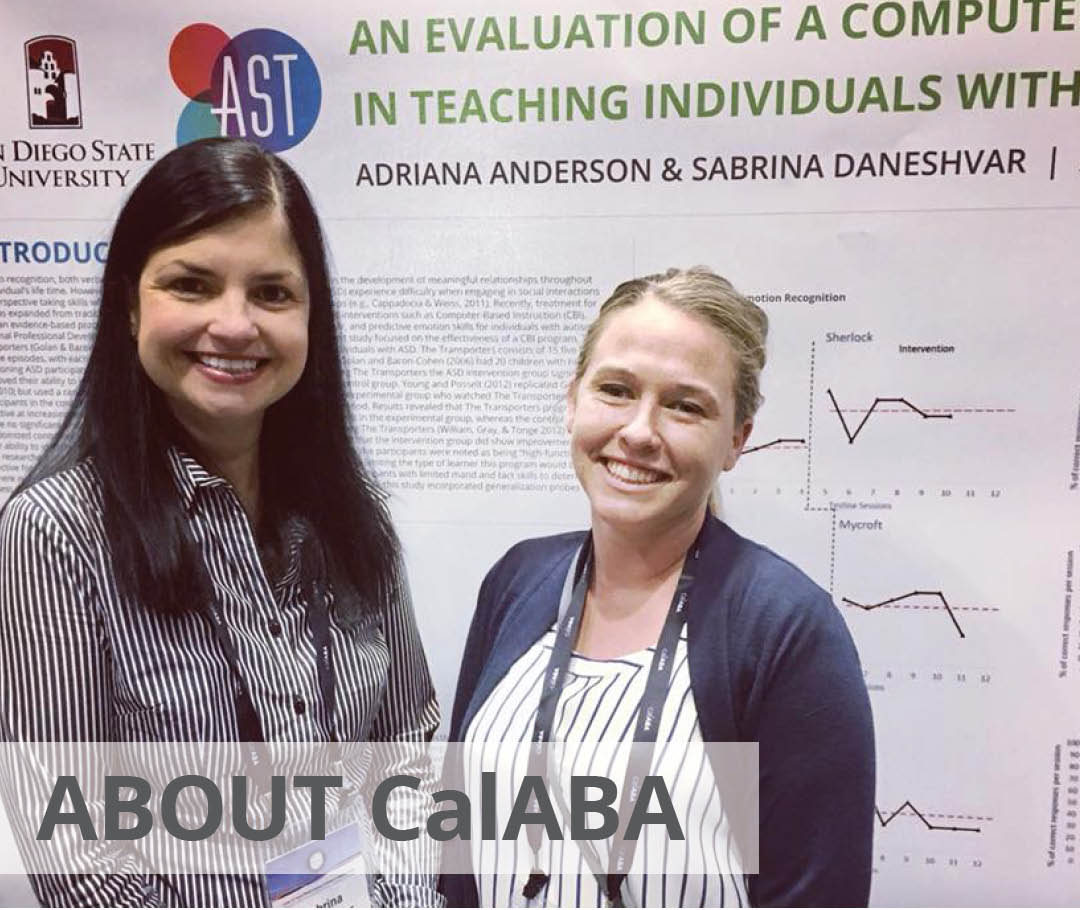
I’ve been thinking about what has my team all abuzz every year leading up to the excitement of going to CalABA. It always seems to bring about a renewed energy and vigor for seeing clients and finishing those last couple reports. The idea of taking a break from our typical week to learn more about our science is invigorating for us clinicians. And the opportunity to see some of the greats in our field share excellent insight and new research, has some of us giddy about soaking up as much as we can. The likes of Dr. Daniels, Dr. Malott, Dr. LeBlanc, and Dr. Dixon create the SHORT list of invited speakers, and it sparks the enthusiasm we all felt in grad school. While we won’t buy backstage passes, or wait in line for three days to get their autographs, these names are definitely some of the rock stars of ABA. The opportunity to see them in person brings a thrill for even the most conservative among us.
But there is more to it than just the fan frenzy. Yes, getting those CEU’s is always important, but you can get easily get one online these days. We go to CalABA because we get something more. Community. It’s that feeling of satisfaction that comes from attending one of the sponsored events and purchasing a glass of wine with your ticket that seem to be worth more than gold. Its the thousands of pieces of luggage being stored in the lobby because we all checked out at the same time on Saturday to save one extra night’s hotel fee. Its not minding that your flight got delayed (again) because it allows you one more drink with friends I haven’t seen since last year.
CONNECTEDNESS! I think that is what we get at CalABA that is truly special. The chance to see colleagues and coworkers that have become friends. The chance to connect with those you haven’t seen in two years because last year you had a baby, or to show those new BCBAs how to scan in and out of each session. The chance to share stories and laughs with those that truly understand what we all go through and how much we care.
Our field can be isolating at times. We spend so much time with our clients that it is possible to go long stretches without seeing coworkers. But something about being at CalABA, just seems to put us all at ease – even when the line at Starbucks is taking forever – and I’m going to be late to Dr. Bailey’s talk – and I might still need 2 Ethics CEU’s… but I really need a double shot right about now. There is something about the safety of being surrounded by people that just get my daily struggles and triumphs, and who understand why I might be over the moon excited because a client initiated play with a sibling without a prompt.
I’m looking forward to being connected to everyone yet again. And while I’m always excited to learn from some of my idols and mentors, I’m equally as excited to hear how your week went. See you there!
Richie Ploesch